Bring a bit of feng shui into your home

featured last month on SheKnows.com, article by Sherri Kuhn 

The entryway to your home sets the tone for your whole living space, but what about the effect it has on your career success? Feng shui suggests that black and other dark colors have an impact on your success. We spoke with feng shui experts to find out how we can incorporate these concepts into our own homes — and boost our careers at the same time.

How does feng shui relate to your career?

The Kan Gua is located near the front entry, and is the career area of a home. "The colors of the Kan Gua are black, navy blue and dark blue," says Diana Hathaway Timmons, color expert at About.com, interior designer and author of Sell Your Home Without Losing Your Zen. "Decorating with these colors in the Kan Gua of your home can enhance career opportunities." She stresses that while using these colors is beneficial, it is important to approach it in a balanced way, or it will create the opposite effect. "Feng shui is all about balance, and that includes the use of colors," she adds. "Using large amounts of dark color in the room traps the chi (energy) and will defeat the purpose of using color as a career enhancement."

Your face to the world

Visualize the front entry to your home, which is what people see first when they approach your home or enter it. "The entry and front door of your home represent your face to the world, how the world sees you and how easily opportunities can come to you," says Anjie Cho, registered New York State architect and feng shui interior designer. "The entry is also related to your path in life as well as the season and energy of winter," Cho adds. "Using black to emphasize water and career will increase your career success. The colors black and dark blue, the number one, wavy shapes and the element of water symbolize this area."

...read full article

by Anjie Cho


eHow.com Video: How to Decorate A Room With Water Fountains and Plants

How to Decorate a Room with Water Fountains and Plants

How to Decorate a Room with Water Fountains and Plants

Water fountains, available in a variety of styles and sizes, add beauty and harmony to a space while improving air quality and mood. Pair with plants for an ideal design.

see more eHow.com videos here

Video Transcript:

Hi, my name is Anjie Cho, and I would like to share with you tips on how to decorate a room with water fountains and plants. Since I’m a feng shui designer, I will also share with you the feng shui applications and meanings.

Water fountains are a great way to add beauty, sound, and humidity for a tranquil and harmonious space. The soothing sounds of water trickling can relax your mind and lower stress levels. The circulating water also releases negative ions which help to purify the air, just like with waterfalls and the ocean. The negative ions produced by the circulating water improve mood and feelings of well-being. The water also creates humidity that moistens the air for humans and for plants – it’s a natural humidifier.

There are different types of fountains that you can have in your home. There are floor fountains that are often tall – they sit on the floor. They are nice to locate next to a wall. There’s also wall-mounted fountains that you can hang on the wall. Be sure to get them installed by a professional with the correct tools and wall anchors, because the wall-mounted fountains can be really heavy.

What I have here is a tabletop fountain. It’s the smallest and easiest way to incorporate a fountain into a room. The tabletop fountains fit easily on a shelf, desk, side table, or anything with a horizontal surface near an electrical outlet. This one is made with resin, stones, and a black metal base. It’s in the shape of a lotus flower, which is a metaphor of beauty coming forth from any situation.

There’s also fountains made with different materials, such as stainless steel and copper. Stone and ceramics are also frequently found. And, sometimes they’re made of resin like this one, that it could be made to simulate different things like natural stone. The style depends upon the décor of your home. Some have lighting, others do not.

In feng shui, water fountains add the element of water to a space, which represents wealth, abundance, and cash flow. An ideal location is near an entry, which is said to stimulate cash to flow into your home from the outside. If used in this manner, it’s better to have a fountain that has a water flow up, and then down. If it’s directional, the flow should be into the home. That way, the wealth flows into your space and not out of your space.

Be sure to maintain them well – nothing’s worse than a fountain with funky water, algae, and slime. Many manufacturers suggest that you use only distilled water. Most tap water has minerals in it that will develop deposits on your fountain and clog the pump. If they do develop, scrub them as soon as they show up so they don’t become permanent. You can also add hydrogen peroxide to the water to inhibit the growth of algae, slime, and other microorganisms. It will keep everything running smoothly. Also, placing the fountain away from sunlight helps prevent algae growth. Never let the pump run dry, so be sure to check the water levels regularly. If it does run dry, it will shorten the life of the pump.

Finally, plants pair perfectly with fountains. The fountain provides negative ions, and the plants provide oxygen. The larger fountains can house plants within them. If you have a small fountain like this, it’s really beautiful to surround it with potted plants, and you can have stands to create a tiered effect.

I’m Anjie Cho, feng shui interior architect with Anjie Cho Architect, and founder of Holistic Spaces. And, this is has been how to decorate your room with water fountains and plants.

by Anjie Cho


Space Clearing with Sage

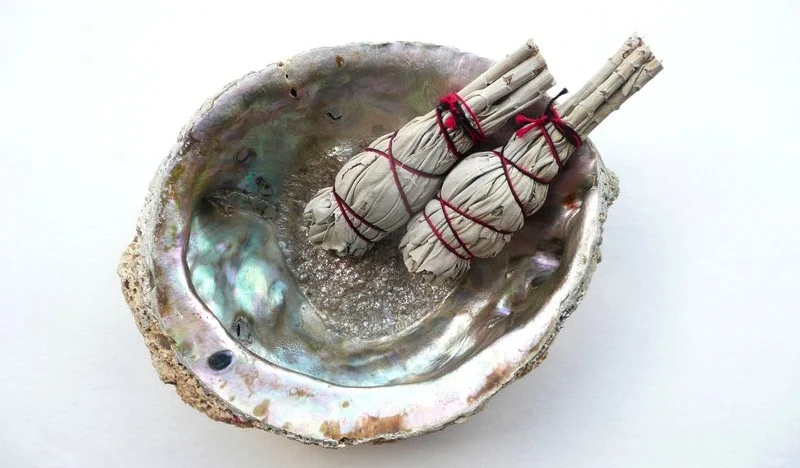
If you’ve ever heard the term “smudging” and it wasn’t in reference to mascara, you probably know what saging for space clearing is. Or at least that it exists. Smudging is not a feng shui term, and for our purposes, we will refer to it as saging, but essentially, they are one in the same. Saging dates back hundreds of years, and although it is known to have been present in many cultures, the most relevant and popular history of this practice comes from the American Indian. Native Americans utilized saging based on the idea that during this process, smoke attached itself to any negative energy, and when the smoke dissipated, any negative energy was taken along as well, thus clearing the room of these not-so-friendly vibes. Some research also makes a symbolic connection between the transformation of physical herbs into their spiritual form as smoke. The art of saging is still alive today and can be used for the feng shui practice of space clearing.

Though there are various types of sage, the most commonly used plant for the process of smudging is white sage, which often comes from California, and therefore is referred to as California White Sage. White sage can also be identified by its plant name, Salvia Apiana. Interestingly, the latin term “salvia” is actually derived from the term “to heal,” which serves as another testament to the history of saging. In addition to being most common, white sage is also the most recommended type for use in saging, although it is said that, provided it is dried, garden sage will also work. White sage is recommended, but for the most part, it is the intention behind this practice that grants the process its power. It is worth noting that whatever sage you choose to use, you should make sure it’s pure and organic, otherwise burning it and breathing in the smoke could be very dangerous.

Once you’ve collected the sage for your space clearing, there are specific steps to follow during the actual process.

  1. Before doing anything else, it’s important to clear the space you intend to sage. Ensure that the area is physically clean and clear of clutter. Turn off all electronic devices within the space. Perhaps the most important aspect of saging is the idea of clearing your head and focusing on specific intentions.
  2. Once your intention is set, light the sage, then slowly wave it about to extinguish the fire and produce smoke. If you have a sage stick, hold one end and light the other. If you have chosen to use loose sage, be sure to have a fireproof container near to hold the sage as it burns.
  3. Once your sage is smoking, slowly move through your space to ensure that smoke reaches to all corners and places. Be sure to concentrate on specific areas where energy enters the room such as doorways and hallways, and take time to make sure closet and cabinet doors are open.
  4. If you’ve been compelled to sage your space, you will likely know what area needs attention, so follow that feeling. You can also guide smoke in all four compass directions, to the heavens above, to the earth below, and within. 
  5. After you clear a space, make sure to fill it with positive intention!

Some suggest burning incense following the smudging, as sage is a masculine smell with yang features, and the femininity and yin of incense balance this out.

Finally, if possible try to obtain sustainably harvested materials. Do the best you can!

Saging is a great way to clear your space! Although it is not traditionally used in feng shui, it's another tool for creating your own holistic space.

by Anjie Cho