

Photo credit: Amy T. Won
AC: Please tell us about your art!
AT: I'm in love with our natural world, and I believe that if we take the time to explore it and look hard enough, there's much amazement and magic to be found. My hope is to create art that are like enchanting windows to the small and big adventures in life.
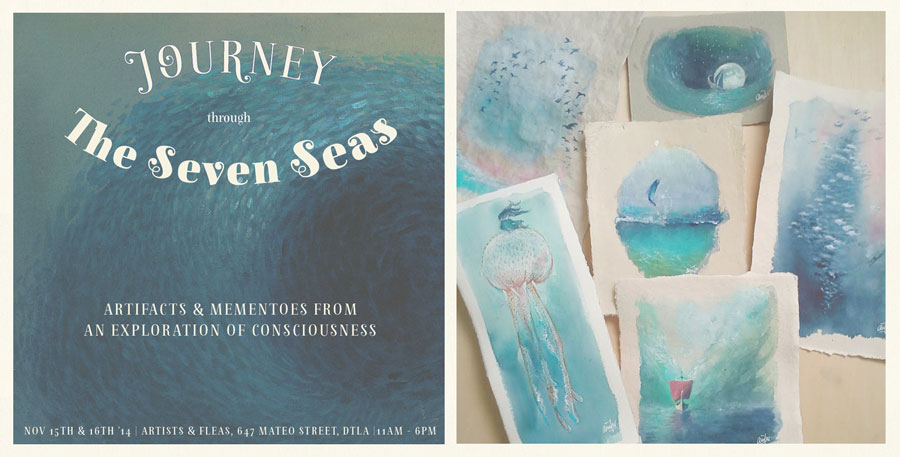
Photo credit: Amy T. Won
I'm currently working on an Explorations series of work, which straddles the line between the real and imagined, between abstract and representational. The current collection is called Journey Through The Seven Seas and is inspired by my own physical and perceived watery adventures. The pieces range from small watercolors on handmade paper framed in shadow boxes to larger acrylics on canvases.

(Display from 'Explorations Part 1: Journey Through the Seven Seas', Amy's traveling art show featuring paintings on handmade paper in vintage and found frames which will be at Artists & Fleas LA Feb 21st and 22nd. )

("Moonrise over Seven Seas", Watercolor, acrylic and casein on handmade paper. )
I just started the second part of Explorations, entitled "Getting Lost" which are larger pieces about plunging into the unknown, getting lost in a world of wonder and the unmapping and unknowing of our inner and outer selves. I'm really excited about this body of work and while I can't show you much, here are a few teasers:

Photo credit: Amy T. Won
How do you think art can set the tone for a space or home?
Art is the quickest way to personalize and create character within a space since it can reveal much about the home owners' tastes and what they are drawn to and like to surround themselves with. Choosing the right art, in the right size, can really strengthen an existing room theme and take it to another level of interest and intrigue. It's also one of the most effective ways to set the stage for a desired mood or atmosphere depending on the size and subject, color, texture, medium and choice of display or framing.

Photo credit: Amy T. Won
Large pieces of art that take up a significant portion of the wall are like windows into another world or clear statements of style. Smaller pieces of art grouped together in the popular gallery style can show taste range, layer and cultural depth, allowing the home owner to curate a selection of images and objects that tell a story or create a certain mood.

Photo credit: Lonny/Patrick Cline

Photo credit: William Waldron
What do you think people should look for when purchasing art for their home?
I always think that people should prioritize choosing art that resonates with them rather than just because it suits the color scheme and texture of the space. While the latter is important, selecting art that first means something to you adds a special layer of your own character and personality to your space, making it more interesting and joyful to inhabit.

Photo credit: Jim Darling
Think of art as the little reminders of qualities you like to surround yourself with-do you like to come home to cheerful joyous color because you're stuck in a drab cubicle all day? Abstracts in your favorite colors that lift the spirit might be your thing. Do you live in the city and yearn for a window into an enchanted forest as a mini reprieve to your daily life? Then perhaps an oversized painted woods scene or landscape tapestry to adorn the walls. Do you love the whimsy and carefree spirit of childhood and hope to infuse more of that into your life? Choosing naive-style art by your favorite artists would be a wonderful reminder to stay young at heart always.

Photo credit from left:
Lola Donaghue,
Print by Dan Isaac Wallin,
Gouache on Paper by Kelly Louise Judd
When choosing art, the most important part is to consider the size of the wall it's going on and what furniture and objects will form the 'vignette' around it. It's always helpful to think of the art wall as a 'story' -what is it saying? How do you want it to feel? What is the mood you are trying to create? Make sure the art is proportional to the wall it's on, breaking rules of scale only if you are confident in the resulting drama.

Photo credit: Mike Kelley
Consider color and texture, though it's not necessary to match the art to the furniture and furnishings unless you're trying to design to a particular mood or theme. Consider whether it is framed in glass (usually heavier) and make sure that this would work in your space. Think of different types of art, not just painted ones-try tapestry, area rugs, flat sculptures, maps, masks, vintage book pages and so forth.

Photo credit: Jan Baldwin
What do you suggest people should look for when purchasing original art?
Price is one of the first things people think about when purchasing original art, after deciding if they are drawn to it. There are many artists who offer emerging collector prices on some of their art for those attracted to original art but unsure if they can afford the high prices. These can be studies or experiments that are not in gallery-ready, finished quality. Pieces like these can be a charming addition to your collection, beautiful in the honesty of their imperfection and transparency of process.
Make sure to ask if the art is created on archival materials and what the suggested care for it is. Original watercolors framed in glass should be displayed away from sunlight and moisture. Are the oils or acrylics varnished? Is there a warranty for damaged frames?
Is the piece signed by the artist? Does it come with a Certificate of Authenticity? Some folks like the extra touch of receiving one as assurance that the piece is what it claims to be.
Shopping for original art is a fun process, let your heart guide you and if an artist's work resonates with you, make sure to stay in touch, their future pieces might appeal as well.

Amy T. Won is the artist, storyteller and enchantment-seeker behind The TreeSpace Studio, where she shares her explorations and painted mementos of our wonder-filled world. You can also find her adventures on Instagram (amytwon) and Facebook (The TreeSpace Studio) or take a peek into her inspirations on Pinterest (Amy Won).


